Edid militia
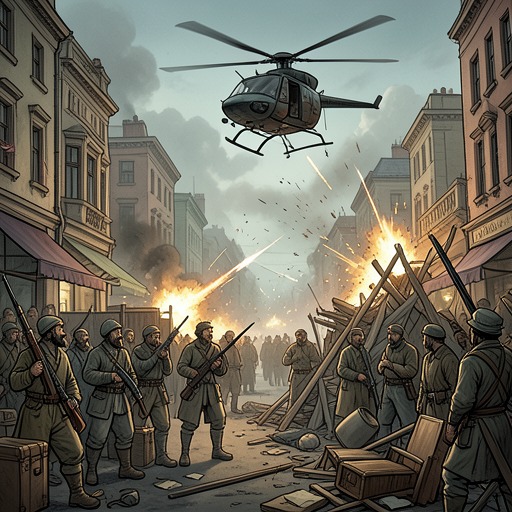
Black Hawk DownAidid's militia was the armed force associated with Mohamed Farrah Aidid and the Habr Gidir clan, and its rapid mobilization helped turn the October 3, 1993 American raid in Mogadishu into a battle across the city. The account presents it not as a force confined to a single front, but as fighters operating from many positions in a crowded neighborhood, where armed resistance and civilian presence overlapped.
Affiliation and role
The militia was linked to the Habr Gidir clan, described as led by warlord Mohamed Farrah Aidid. The October 3 operation aimed to capture two of Aidid's senior lieutenants at a gathering in central Mogadishu. United States Army Rangers were to establish a perimeter around the target block while commandos entered the target building; a convoy of 12 vehicles was waiting to transport the assault force and prisoners back to base. The operation was therefore directed at Aidid's leadership, but its conduct depended on getting the troops out through the surrounding city.
The scale of the planned assault contrasted with the dispersed resistance that followed. The helicopter force included about 75 Rangers and 40 commando troops in 17 helicopters, while the ground convoy waited at the airport. As the aircraft approached the target, burning tires on a nearby street were considered as a possible sign of militia activity, but investigators judged those tires had been set earlier in the day. The apparent warning did not lead to an abort; the raid proceeded.
Mobilization and resistance
The militia's preparations for the approaching force were already underway before the Rangers fast-roped onto Hawlwadig Road. Abdikarim Mohamud, a Somali employee at the U.S. Embassy compound who was also acting as an informant for his clan, knew the Americans were headed toward Bakara Market and understood that the troops would need a vehicle column to leave. He learned that militiamen were preparing ambushes and roadblocks on streets around the market. This account makes the convoy's vulnerability part of the militia's response: the ground route out of the target area was not an afterthought, but a foreseeable point of confrontation.
Once the battle spread, Abdikarim perceived the militia fighting from hundreds of locations in the densely populated neighborhood. Continuous gunfire and helicopters passing low overhead made the fighting seem to fill the sky and streets. His experience also shows the limits of treating the neighborhood as a uniform battlefield: he first sheltered with his family in the courtyard, then ventured out for news of relatives near the market. Near the fighting he saw dead men, women, and children, an American soldier wounded and hiding by the road, and a Little Bird helicopter firing down an alley. He escaped to a friend's house, where people remained on the floor as shooting continued through the night.
Civilians within the fighting
The militia's resistance took place amid a civilian population that gathered in the streets during disturbances, sometimes alongside people carrying weapons. The Rangers' rules of engagement restricted firing to people who pointed weapons at them, but the account describes how difficult that distinction became as armed people, women, and children appeared together. That context does not establish that every armed person was a militia member, nor that every civilian present was involved in combat; it shows why the boundary between the force and the surrounding population became consequential and hard to maintain.
One convoy episode exposes the danger of making that distinction under fire. A woman in a purple robe ran beside a vehicle with a baby in her arms. A Ranger initially shouted for the driver not to shoot because she had a child. The woman then turned and raised a pistol with her free hand; another Ranger shot her repeatedly, unable to tell whether the baby had also been hit. The incident does not identify her as a member of Aidid's militia. Instead, it captures the uncertainty and civilian risk created by fighting in streets where people and weapons could appear together without warning.
Consequences and significance
As the battle continued, the original capture mission became a pitched fight, and the militia's preparations around Bakara Market compounded the danger of moving ground forces through the city. On the American side, the account records a change in the rules of engagement during the return to base: Dale Sizemore, numb and angry after the losses among his fellow Rangers, fired into crowds that included young boys, some armed and some not, as well as women moving among men with rifles. These acts are not attributed to the militia; they show how the battle's pressure and the collapse of restraint extended its costs beyond exchanges between organized fighters.
The militia's significance in the narrative lies in both its armed resistance and the setting in which that resistance unfolded. Its fighters could block routes and engage American forces from numerous positions, while civilians lived, moved, and sought shelter within the same urban space. The result was a raid whose military objective could not be separated from the wider confrontation between the United States and Aidid's forces or from the danger imposed on Mogadishu's residents.